
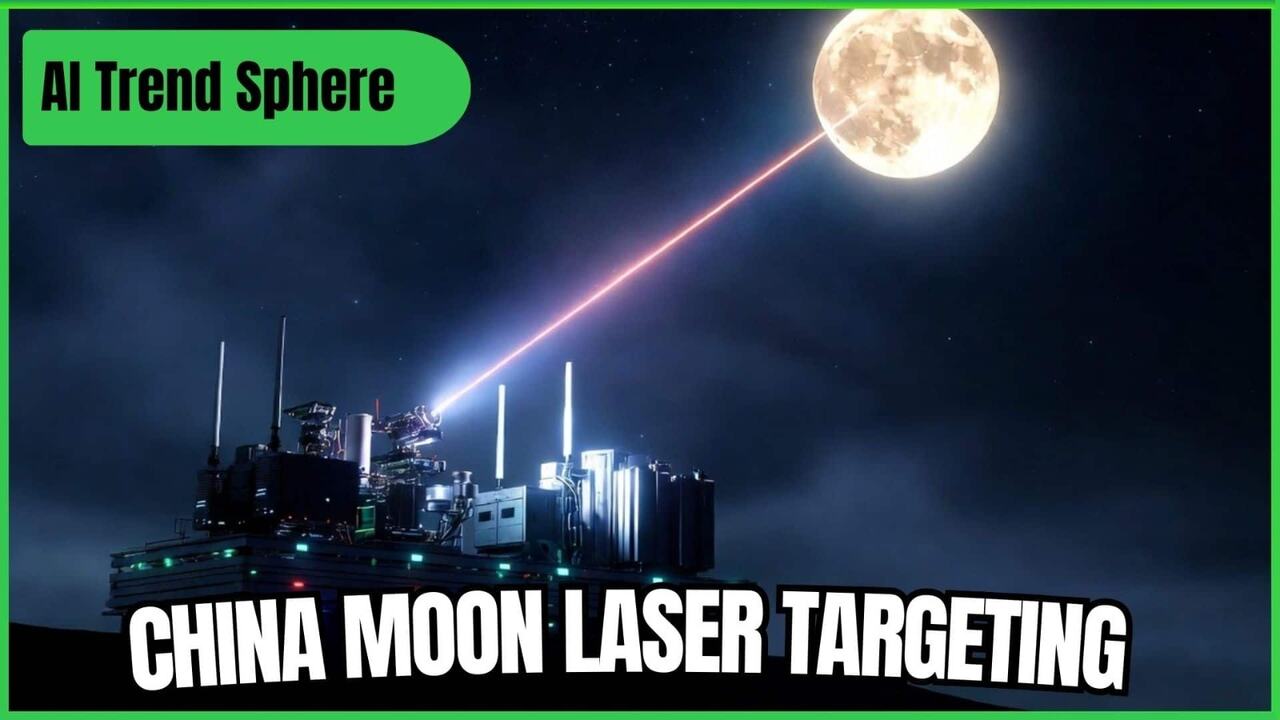
China’s lunar exploration: What is the real discovery amid rumors of ‘laser targeting’ on the moon?
For decades after the Apollo and Luna missions, the moon retained its secrets, and in 1976 an era ended with the return of samples by the Soviet Union. Then suddenly, the moon race started again. The new SpaceX rocket, NASA’s Artemis program, and China have quietly stepped in a direction where no one has gone before.
Whispers began about strange discoveries on the far side of the moon. What exactly was found under the lunar dust? And why is everyone going back?
1. What China is searching for on the Moon: Is it just national pride or a race for Helium-3?
China’s lunar exploration began in the early 2000s, led by the China National Space Administration (CNSA), and then proceeded under an ambitious plan. Their goals were a blend of science and strategy, leading China to emerge as a space power.
Chang’e-1 (2007): Made a 3D map of the lunar surface and analyzed the composition of the soil. It found signs of helium-3 in the regolith, an early sign of China’s resource ambitions.
Chang’e-3 (2013): China’s first soft landing on the Moon, which deployed the Yutu rover. It was the world’s first lunar landing since 1976.
Analysts believe China’s focus is driven by its pursuit of strategic resources, including helium-3, metals and water.
Helium-3 is called the ‘Treasure in the Dust’. It is rarely found on Earth, but is abundant in the soil of the Moon. In theory, helium-3 could power nuclear fusion reactors, providing large-scale clean energy. It is estimated that the lunar regolith contains more than one million tons of helium-3, enough to power the Earth for thousands of years.
2. Why was it so difficult to land on the far side of the Moon, and how did the “Magpie Bridge” make it possible?
In 2019, Chang’e-4 was sent to visit the far side of the Moon. Therefore, It was to create history by becoming the first spacecraft to land there, a feat that no other nation had achieved.
Challenge: The far side of the Moon is always far from Earth, which is hidden from our radio communications. Because of the Moon’s mass, any probe from the far side cannot contact Earth without a relay.
Solution (Queqiao): China proposed a dedicated relay satellite, Queqiao (Magpie Bridge). It was positioned at the Earth-Moon L2 point, allowing it to maintain constant contact with both Earth and the far side of the Moon.
On January 3, 2019, Chang’e-4 landed in the von Karmann Crater, which lies within the vast South Pole-Aitken Basin.
3. What strange “mysterious gels” did the UTU-2 rover discover?
In mid-2019, operators of the Yutu-2 rover noticed something unusual in a small crater — a shiny, textured spot that stood out from the surrounding soil.
Speculation on the Internet: What could be viscous or liquid on the moon? Was it volcanic glass? Or something else weird?
The original discovery: A luminous dark matter was revealed in the released images. Scientists identified it as breccia—soil and rock fused by the heat of a meteorite impact. It was essentially molten, glassy moon rock, similar to the samples from the Apollo missions, but discovered in a completely new location.
4. Is life possible on the moon? Why did the cotton plant not survive?

Chang’e-4 also conducted a small biosphere experiment among the gray wastelands. It was a bucket-shaped sealed container filled with soil, seeds and insect eggs.
Historic moment: In January 2019, scientists announced that a cotton seed had germinated inside a container. It was the first plant in human history to grow on another celestial body.
Conclusion: However, the plant did not survive for long. Two weeks after the landing, the lunar night began and the temperature dropped to 52 . As the heater was turned off, the seedling died as expected.
Significance: This experiment was an important milestone. It’s an essential step toward establishing long-term lunar bases, where astronauts could one day grow food on the moon.
5. Will these Chinese discoveries make the moon the center of the next “Gold Rush”?
Chinese lunar orbiter and rover missions have been mapping the distribution of helium-3 since its inception. This valuable gas has the potential to become a “gold rush” for lunar mining in the future. Chang’e missions are effective resource explorers surveying the most promising sites.
Chang’e-5 (2020): Samples from this mission discovered a new mineral called Chang’e site-Y, which interestingly contained traces of helium-3.
China’s exploration of the far reaches not only piques scientific curiosity but also signals the start of a new lunar energy race, focused on finding fuel and resources for future colonies. China’s Lunar Exploration: Mysteries and the Race to the Future
6. Did China discover an alien artifact on the moon? What was the secret of “Mystery Hut”?
The secrecy surrounding China’s lunar missions and the mystery surrounding the far side of the moon has given rise to many conspiracy theories on the Internet.
Speculation on a gel-like substance: When news of a gel-like substance first came out, outside commentators speculated about everything from living organisms to secret bases. However, it later proved to be molten rock (breccia).
The mystery of the “Mystery Hut”: In 2021, UTU-2 spotted a cube-shaped shape on the horizon, which was immediately named “Mystery Hut”. Talk of a monolith or an alien cabin began on the Internet.
The truth revealed: In fact, it became clear that the cube was just an oddly shaped boulder on the edge of a crater. It looked like a hidden rabbit, which was quite appropriate for the name Jade Rabbit.
7. Is China’s military planning to build a spy station on the moon?
Due to the military ties to China’s space program, concerns have been raised about potential ulterior motives on the far side.
Strategic Concerns: Furthermore, Some observers believe that a base on the Moon could be used to hide activities or as a secure surveillance or missile launch detection point from Earth.
No Evidence: However, there is no evidence that Chang’e-4 carried anything other than scientific instruments. Its payload was published publicly and included contributions from European countries such as Sweden and Germany.
New Space Race: As the US and other countries return to the Moon, the timing and focus of China’s efforts has fueled talk of a new space race.
8. Why is exploration of the polar regions important for water ice? Will a permanent settlement be made on the moon?

In recent years, several missions such as NASA and India’s Chandrayaan-1 have confirmed that water ice exists in the moon’s shadow craters, especially at the poles.
Importance of Water: Water is invaluable for sustaining life and splitting it into hydrogen-oxygen rocket fuel.
China’s plan: China’s leadership is paying attention to this. Soil analysis data from Chang’e-5 also found hydroxyl water at mid-latitudes.
Indigenous Resource Utilization (ISRU): China’s program envisages In Situ Resource Utilization (ISRU). This means that astronauts or robots can dig up ice, melt it into water, and turn it into breathable oxygen and hydrogen fuel. In conclusion it is important for the establishment of permanent lunar settlements.
9. Who will own the resources of the moon? Could this start a new international conflict?
CNSA plans to build an International Lunar Research Station (ILRS) in the 2030s, in partnership with other countries. But an important question remains unresolved: Who owns the lunar resources?
Legal Framework: Currently, the 1967 Outer Space Treaty restricts sovereign claims to the Moon.
New Disputes: As countries prepare to extract resources (such as helium-3), new international agreements or potential conflicts may emerge.
Strategic Implications: In fact, It is clear that the nation that leads the exploration and use of lunar material will have a significant impact on these regulations. The Moon has become the centerpiece of the 21st century space race.
10. China vs US: Will there be two rival bases on the South Pole of the Moon by 2030?
After the Chang’e missions, all major space powers have accelerated their lunar programs.
China’s Roadmap: China is planning the Chang’e-7 and Chang’e-8 missions in the late 2020s, targeting the southern polar region.
Chang’e-8 will test ISRU-like technologies.
In addition, By the early 2030s, China hopes to establish a core research station on the South Pole of the Moon.z
Direct competition: Moreover, China has announced plans to deploy taikonauts by 2030. For the first time in 2024, Chinese officials described the US as a direct competitor in the race to the moon.
Future: A Chinese strategic report predicts that in the next 20 to 30 years, China’s ILRS and America’s Artemis base will operate together on the south pole of the Moon.
laser ranging technology, lunar laser experiment, lunar laser experiment, satellite tracking laser, space based weapons, moon observation technology, china space program,future of space warfare, aser communication in space
