
F-47 Fighter Jet: US Air Force’s Next ‘Air Dominance’ Game Changer
In March 2025, the United States unveiled the F-47 fighter jet, the Air Force’s first new sixth-generation fighter jet. It is a result of the long-running NGAD (Next Generation Air Dominance) fighter program. However, in December 2024, China surprised the world by showing not one, but two different sixth-generation aircraft prototypes. There was a media frenzy, and the US was expected to retaliate. The response came in the form of the F-47—a plane that would not only be the most advanced fighter jet, but would also counter China’s growing dominance and save aircraft manufacturer Boeing in a way. This is the story of the mysterious, incredible, and brand new Boeing F-47.
1. F-47’s Mysterious Design: Secret of ‘Tales’ Stealth
A closer look at the 3D render of the F-47 reveals one interesting thing, its tailless design. This decision is not new. In the late 90s, McDonnell Douglas (later acquired by Boeing) built a test bed called the X-36. The X-36 did not have vertical stabilizers, which increase the radar cross-section (RCS) of the aircraft. By removing this design, the aircraft becomes more stealthy, as well as its maneuverability and range. The F-47 will also adopt this new optimized design, which is essential for modern fighters, especially in response to Chinese jets.
2. AI and Drone Coordination: The F-47’s Multi-Role Strategy
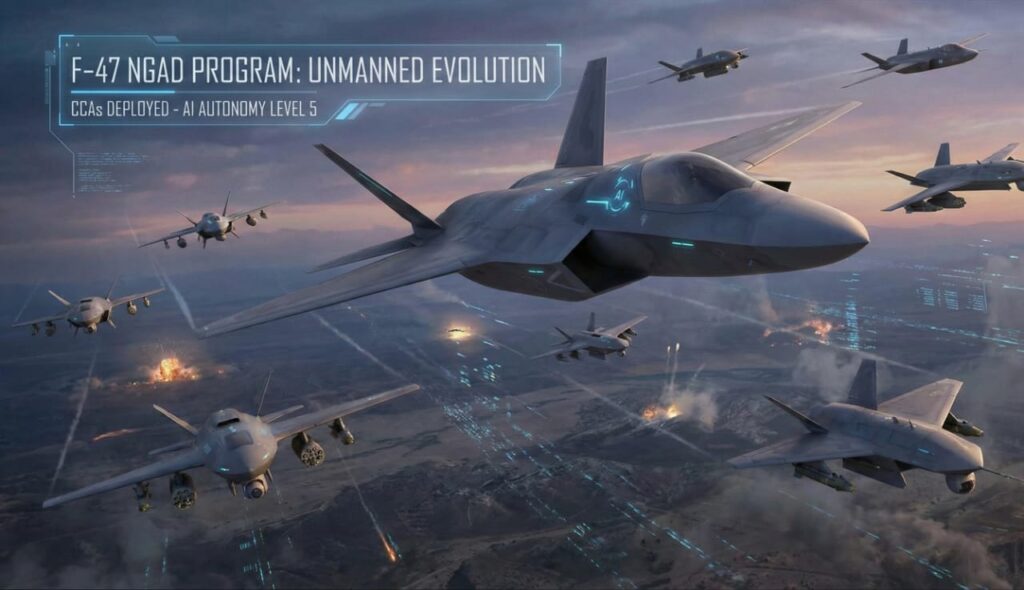
The F-47 won’t just be a fighter; It will act like a “quarterback“. It will have the ability to work together with drones (Collaborative Combat Aircraft – CCA). These drones will either act as force multipliers or perform parts of the mission to focus on the pilot’s main objectives (such as screening, scouting, or black ops). Ultimately, it aims to be an unmanned platform, controlled from the ground or by artificial intelligence (AI).
3. Upgraded Technology: Photonic Radar and Unmatched Sensors
A big plus point of the F-47 will be its systems. The US Air Force will use this as an opportunity to upgrade its radar, electronics and sensor suite with the best available technology. Given that the F-35’s technology is also unmatched in the world right now, this shouldn’t be much of a challenge for the F-47. One of the things that will change the air warfare system of the future can be the development of Photonic Radar, which is expected.
4. Beyond Visual Range: The main weapon of the F-47
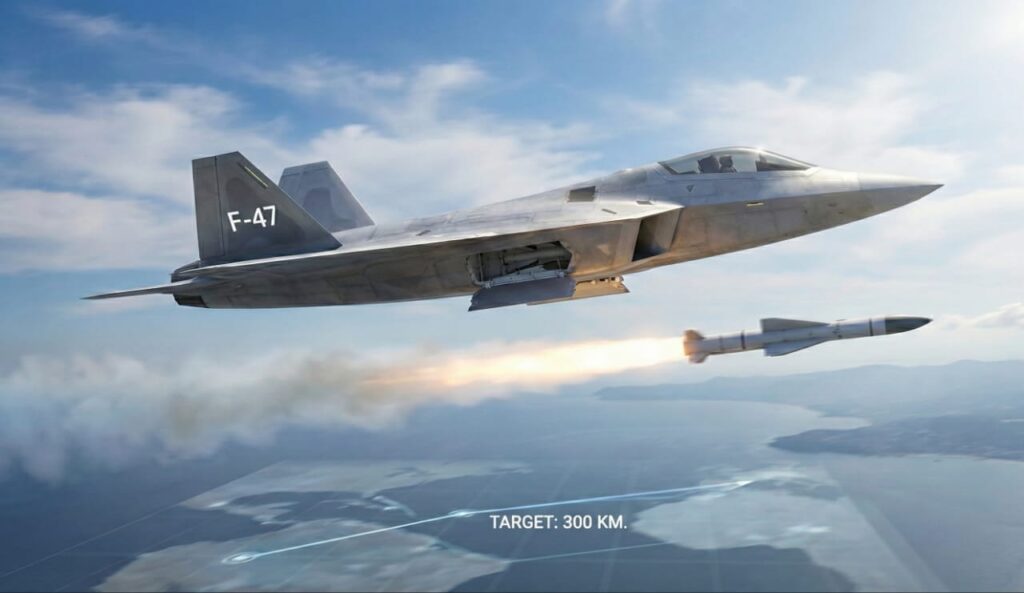
The F-47’s main weapon will be long-range radar-guided missiles, which are also being developed in secrecy. Meeting the major need for future air warfare, these missiles are likely to have a range of at least 200 or perhaps 300 kilometers, which would give them the ability to target over the horizon. This is clearly an evolution of the program that began as a replacement for the F-22 Raptor, with a greater focus on multi-role capability.
5. Killer Price: Will the F-47 Bankrupt the US Air Force?
A major threat to this program is its cost. According to former Air Force Secretary Frank Kendall, the F-47 is expected to cost at least twice as much as the F-35. Since it likely won’t be an export aircraft like the F-22, international sales won’t cover the cost, which could cost a single aircraft several hundred million dollars. Boeing had to make a big bet to win the contract, which started at $20 billion, which could now turn into a production order worth hundreds of billions of dollars.
Boeing’s Unexpected Bet: The Inside Story of the F-47 NGAD Contract
6. Lockheed Martin’s shock: The balance of the US defense industry with the F-47
Winning this contract for Boeing was not just a big deal, it was a lifesaver for the company. It was a sharp blow for Lockheed Martin, known for stealth fighters like the F-22 and F-35. Lockheed shares fell nearly 7% after the loss.
However, from a broader industrial perspective, the US Air Force’s decision was strategically logical. By awarding the contract to Boeing, the Pentagon kept at least two major fighter jet manufacturers alive and well. Excessive reliance on a single defense firm is a serious concern. If Lockheed were to win the NGAD, it would become the sole manufacturer of advanced fighter aircraft. The F-35 program has already experienced huge cost and schedule problems due to being a single supplier. Boeing’s success ensures competition in the high-end fighter space, which will super innovation and help control costs in the long term.
7. In-depth investigation at Boeing: $7 billion overruns stain
The F-47 victory is a golden opportunity for Boeing, but it is also the biggest test for the company. Boeing’s defense side has had a poor track record recently, including losses of more than $7 billion on the KC-46 Pegasus tanker project and $2 billion on the new Air Force One jet.
The bigger the NGAD victory, the greater the scrutiny. US lawmakers and defense officials have clearly warned Boeing that they must deliver on time and within budget. The Air Force cannot afford to let NGAD fail. The successful execution of the F-47 program will define Boeing’s future position in the defense sector.
8. Preparing for the future: The ultimate goal of the unmanned F-47
When this announcement was made, the first question raised was why there is a need for human-crewed aircraft even in the late 2020s, when drones rule the skies? As mentioned earlier, the F-47 program includes companion drones (CCAs), but it still focuses on the human pilot in the cockpit.
However, the ultimate goal is to develop an unmanned NGAD version, when reliance on AI becomes sufficient. In a war-like situation, the Air Force can rush the F-47’s support systems (such as drones and weapons) into service before they even take to the field. This shows that the NGAD program is not just a fighter jet, but a flexible program that can adapt to world events.
9. Dealing with the challenge: Will Northrop Grumman become Boeing’s partner?
If Boeing rises to the challenge and delivers a superior F-47 on time, it will vindicate the Air Force’s decision. Boeing has recently reorganized its defense unit, hired experienced program managers, and is working closely with Air Force teams, indicating that they are taking this challenge seriously.
If Boeing succeeds, it could also become a strong contender for the Navy’s sixth-generation fighter, giving the U.S. a unified family for both the Air Force and Navy in the form of the F-47B. On the other hand, if Boeing falters, there could be serious consequences; The Air Force may have to invest more money or team up with partners like Northrop Grumman to get the program back on track.
10. The New Rules of Air Warfare: The F-47 is Writing History
The selection of the F-47 as the NGAD fighter marks the beginning of a new chapter in US air power. It comes after years of secret development and intense rumours, and it sets the stage for innovations we can only partially imagine. The coming years will tell if the F-47 lives up to its role as a cornerstone of 21st century air dominance.
In the words of one Air Force leader, “With the F-47, we are going to write the next generation of modern air warfare.” And the world is watching that story unfold.
sixth generation aircraft, AI-powered fighter jet, stealth & radar evasion, hypersonic speed fighter, next-gen air combat,unmanned combat aircraft, future military aviation, US Air Force projects
