

China’s new ‘J-36’: Is the dominance of Western air forces about to end?
In December 2024, China chose a different path to demonstrate its military might. While the US keeps its secret projects under wraps for years, China shocked the world by flying its new Next-Gen Stealth Flying Wing aircraft in the open sky in front of everyone.
Does the J-36 have a global answer?
Named ‘J-36’ by experts, this aircraft is a huge, fast and stealth platform.Most shockingly, no western air force currently has an active operational aircraft like it. This reflects the leap forward in China’s aviation industry, where it is now building its own futuristic technology rather than copying Soviet designs.
Three-engine mystery: Why is it so powerful?
The J-36’s most distinctive feature is its three-engine and tailless design. This design not only protects it from radar sighting, but also gives it the ability to carry heavy payloads (weapons) over long distances.
Strategic Significance: It can completely change the balance of power in the Indo-Pacific region.
Is America’s ‘Air Supremacy’ in danger?
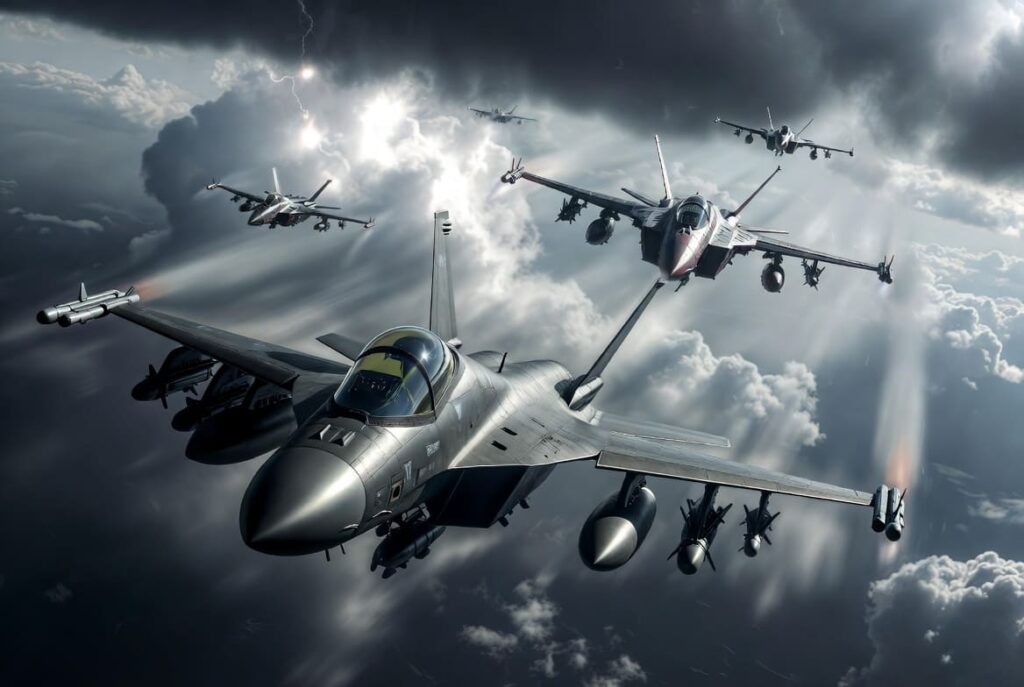
Since 1991, the United States Air Force (USAF) has had a monopoly on the skies. The US was at the forefront of technology with the F-117, F-22 and F-35. But now:
China has not only deployed the J-20 (heavy air-to-air fighter), but also the J-35 (multi-role stealth fighter).
While American programs struggle with budgets and delays, China’s production speed and pace of technological development are unmatched.
How will the air war of the future be?
China’s goal is no longer just to ‘equalize’, but to ‘surpass’. With aircraft like the J-36, China is moving towards an ecosystem where:
Crewed and Uncrewed Teaming: Crewed aircraft and drones will operate together.
Long-Range Munitions: Emphasis on weapons that destroy the enemy from a distance.
Asymmetric Challenge: China is throwing all its might to compete with the expensive aircrafts of America.
Is the Chinese J-36 design just a coincidence?
The laws of physics are immutable in the design of military equipment, especially aircraft. If different engineers are given the same technology and requirements, the solutions they come up with will look almost the same. This is why the Chinese J-35 and the American F-35 are similar. If you want a medium-sized, stealthy multi-role fighter, then its shape and form will be the same as the one that meets the principles of aerodynamics.
What is the purpose of the tailless design?
The most striking feature of this new aircraft (temporarily called the J-36) is its lack of vertical control surfaces, or “tails.” This design makes it clear that stealth has been prioritized over maneuverability in the development of this aircraft. While the lack of a tail reduces the aircraft’s ability to turn and turn in the air, it also reduces the risk of radar detection.
Is this aircraft sacrificing agility for speed?
Unlike the American B-2 Spirit or B-21 Raider, this aircraft is not based on a full “flying wing” design. This is an indication that the designers have prioritized speed over stealth from all angles. Another surprising thing is its three-engine design, which had been almost extinct in modern fighter aircraft since World War II.
What does the unusual size of the aircraft indicate?
By the standards of modern fighter jets, this aircraft is very large in volume. The increase in the size of the aircraft simply means that it has more space (internal volume) for fuel and weapons inside. This means that this aircraft is capable of striking at longer distances. However, the large size also increases its operational costs.
Is the J-36 a heavy “heavyweight” aircraft?
Compared to the J-20, the aircraft looks quite large. The use of a “twin bogie” design in its landing gear indicates that it is a very heavy aircraft that needs a strong base for takeoff. Its design suggests that it is designed to fly on internal fuel for long distances.
Is agility now secondary in modern air combat?
Previous fighter jets (such as the F-22) used large vertical tails to enable them to turn quickly to avoid dogfights and enemy missiles. But the J-36’s design suggests that China is now relying on broadband stealth and long-range supersonic speeds rather than dogfights. This trend can also be seen in the US ‘NGAD’ program, where survival depends on staying out of the enemy’s sight rather than playing tricks.
Is stealth technology a thing of the past in modern warfare?
It is often argued that advanced artificial intelligence (AI) and powerful sensors will render stealth aircraft ineffective. But if that were the case, why would China, Russia and the US spend billions of dollars on their next-generation aircraft and drones solely for stealth designs? In military strategy, the adage “follow the money” speaks louder than words, and the money of world powers is still being spent on stealth technology.
The truth about the J-36: Is it a fighter or a stealth bomber?
Despite the “J” (Fighter) designation of this aircraft, experts believe that its roots may be linked to China’s long-term “Regional Strike Bomber” program. It is not just a dogfighter, but a stealthy F-111-like aircraft capable of penetrating enemy defenses at long ranges. Its design suggests that it could also be an early prototype of a “sixth generation” fighter program.
What secrets does the internal weapons bay hide?
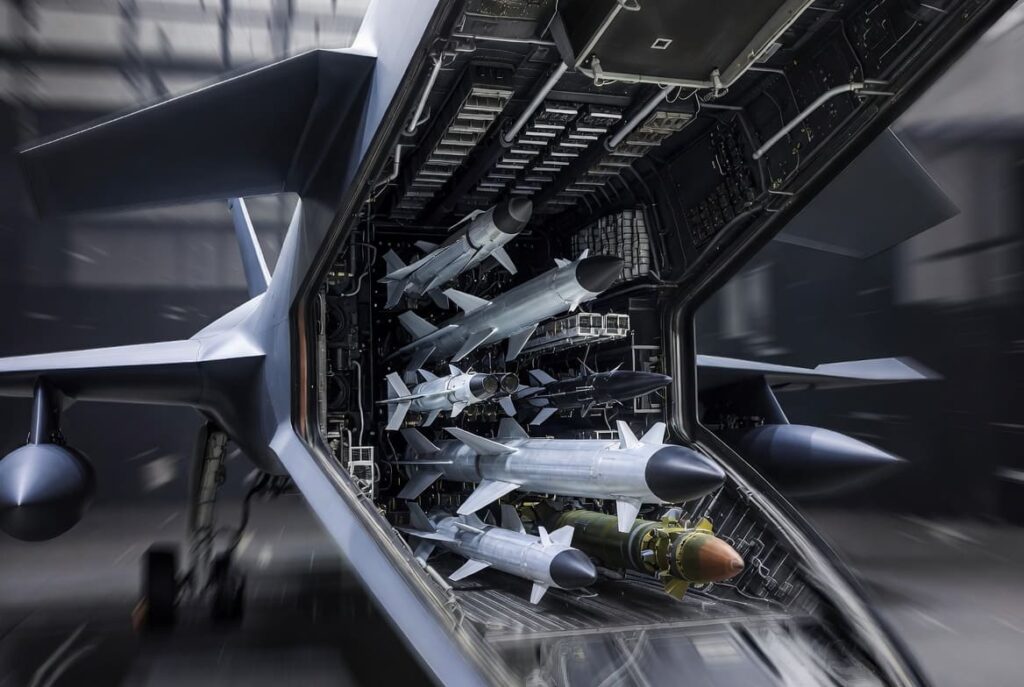
The most important question in the aircraft’s design is the depth of its internal weapons bay. If this part is deeper, the aircraft will be able to carry heavy weapons as a ‘bomb truck’. But if the bay is shallower, it signals a design focused on long-range air-to-air missiles (such as the PL-17), allowing the aircraft to target enemy tankers and reconnaissance planes (including AWACS) from far away.
Can the J-36 pose a major threat to the US fleet?
If the J-36’s weapons bay can accommodate 2,000 to 3,000 kg of Standoff missiles, it would pose a serious threat to US air bases and ships in the region. China has invested heavily in anti-ship and hypersonic missiles in particular, and the J-36 could be the perfect means to silently deliver these deadly weapons to its target.
Future War: Why Are Missiles Replacing Bombs?
Modern air warfare has now shifted from conventional bombing to “stand-off range” (attack from a safe distance). The J-36’s design reveals that it prioritizes launching the latest long-range missiles rather than dropping laser-guided bombs. Whether China labels it a fighter or a bomber, the aircraft aims to strike targets from long distances while avoiding enemy radar.
Key Technical Takeaways: (China large stealth Flying Wing Aircraft)
(China large stealth Flying Wing Aircraft) Three-engine system: The “intake” design that draws air into the engines affects its depth and stealth capability. Unmanned capabilities: Its size and design also make it suitable for future unmanned aerial vehicles (UAVs). Operational maturity: Flying it over densely populated areas in daylight shows that China is very confident in the maturity of this technology.
Is a ‘system of systems’ the key to success in modern air warfare? According to experts, the real concern is not with any single Chinese aircraft (such as the J-36), but with the entry system that China is Developing. China’s main goal is to create a network where sea, air, ground and space assets are interconnected. The purpose of this network is to locate important targets such as US aircraft carriers and refueling tankers and immediately transmit the data to the Nearest Long-Range Missile Platform.
Why is ‘Real-Time Data’ necessary for long-range missiles?
When a missile travels hundred or thousand of kilometers, the moving target (such as a ship or plane) can change its location during this TIME. This is where the role of Stealth Aircraft like the J-36 becomes important. These aircraft can fly close to the enemy and provide the latest target data updates to the missile, so that the target cannot escape the missile’s ‘seeker’. Is the combination of human pilots and drones the future of air warfare? The battlefield of the future will be under the control of Sensors. In such a situation, China is working on three levels: Unmanned Aerial Vehicles (UAVS): Which will move forward and spy in dangerous areas. Ultra-Stealth Aircraft (J-20/J-36): Which will be able to penetrate enemy defenses due to their still characteristics. Conventional Aircraft: Which will attack with a large amount of weapons after the defenses are broken.
What are the Challenges Faced in Network-Centric Warfare?
The future vision is that even if an enemy destroys a seatellite or command center, the system can reconfigure itself to continue operating. The US calls it ‘cjadc2’, but it is a very complex task to implementChina is developing a similar network that enables uninterrupted data exchange between sensors and missile launchers, but achieving this level of integration demands far more effort than simply creating a PowerPoint slide. The ‘Missile Race’: Is Increasing Range Enough?
Countries around the world use two major approaches to increase missile range. The United States follows the SM-6/AIM-174B approach, which boosts range by adding a larger rocket with more fuel. The European/Russian approach (meteor/ramjet): using Ramjet technology, which makes missiles faster and more fuel-efficient. However, simply increasing the range of the missile is not enough, because the Radars of Older Aircraft are not capable of seeing the target at such A distance or Guiding the missile. Stealth vs. Stealth:
Why is close combat still important?
When Two Stealth Aircraft (such as the F-22 and the J-20) come face to face, they will only be able to see each other on Radar when they are very close. In such a case, long-range missiles alone are not enough, but the need for medium and short-range missiles (such as the AIM-120 or Pl-15) also Remains. This is why modern aircraft still fly with a mixed load of different types of missiles.
New era of air warfare: Will China’s ‘secret weapons’ crush America’s pride?
In today’s world, the battle to become a superpower is being fought not only on the ground but also in the vastness of the sky. While on one hand, the United States boasts of its F-35 and F-22, on the other hand, Russia and China have developed missiles and aircraft that can turn the game around.
Dangerous ‘stealth’ missile: A strike beyond the line of sight
(China large stealth Flying Wing Aircraft)
In air combat, the one who has the longest “arm” will now win.
Russia’s ‘Chunkar’ (R-37M): This missile is famous for its longest range, which does not even give enemy aircraft a chance to catch up.
America’s new Panther (A260): The United States is now working on the A260, which aims to achieve a more destructive range in a smaller size.
China’s Masterstroke (PL-17): China’s PL-17 missile is about 6 meters long and has a range of 400 kilometers. This means that this missile can cover the distance from London to Paris in minutes and destroy the target.
J-36: Is this aircraft a killer of ‘tanks’ and ‘AWACS’?
China’s new design J-36 is currently the center of discussion. Experts believe that if China builds a large stealth aircraft that can hide large missiles inside (Internal Bay), it will be impossible for the US Air Force to protect its support aircraft (Tankers & AWACS).
Interesting comparison: While Russia builds a few Su-57s every year, China is capable of producing dozens of J-20s every year. This manufacturing power makes China the most dangerous.
Drone Technology: A Cheap and Deadly Solution
Not only large aircraft, China is now also working on small and cheap drones that will attack very close to the enemy with stealth capabilities. This “kamikaze” approach will completely change future wars.
What is your opinion?(China large stealth Flying Wing Aircraft) 💬
Do you think China has overtaken the US in this technology race? Or does the US still have some “secret trick” that will surprise the world?
Thanks For Reading Blog About (China large stealth Flying Wing Aircraft).
Related Blogs: F-47 fighter jet , China Large Stealth Flying Wing Aircraft
