

China’s Stealth Fighter Jet: Chengdu J-20 – Mighty Dragon
China became the official operator of a fifth-generation stealth fighter in 2017 with the introduction of the Chengdu. J-20 stealth fighter, the second country after the United States to do so. The new jet, dubbed the “Mighty Dragon,” aims to match and perhaps surpass the West in terms of avionics.
What are the characteristics of a fifth-generation fighter jet?
- State-of-the-art stealth capabilities: Exceptional ability to remain hidden from enemy radar.
- Advanced Avionics: The most advanced electronic systems installed in the aircraft.
- Unparalleled Situational Awareness: A complete and clear picture of the battlefield for the pilot.
- Other features: Electronic Warfare, Great Agility, Fast Takeoff, Cruising Speed and Advanced Weapons System.
This fighter jet is far superior to other combat aircraft in every respect.
What is the background to the development of the J-20?
- Global Race: After the Cold War. the United States put the F-22 Raptor into service in 2005 and then began work on the F-35. Giving it a 2-0 lead in the international arms race.
- China’s Entry: In the early 2000s. Western intelligence reported that the Chinese Air Force was working on a fifth-generation fighter, codenamed the JXX program.
- Selection: Two companies, Shenyang Aerospace Corporation and Chengdu Aerospace Corporation, built prototypes. After testing, the Chengdu model was selected for the JXX program.
When did the “Mighty Dragon” make its first flight?
- Announcement: It was officially announced in 2008 that the first flight was expected in a few years.
- First flight: In January 2011, the prototype made its first flight over southwest China.
- Public debut: The J-20 was officially unveiled to the public at the 2016 Air Show China.
- Entry into service: In 2017, Chinese state media reported that the design had been finalized and the aircraft was ready for mass production.
What are the design and technical specifications of the J-20?
- Canard Setup: The most striking feature of the J-20 is the small wings (canards) on the front of the aircraft. This design produces about twice as much lift as a conventional wing and tail setup.
- Performance: China claims it performs best at supersonic speeds, but Western analysts express doubts.
- Pilot: The regular J-20 has a single pilot. However, in 2021, the J-20B variant was seen as the world’s first two-seat stealth fighter.
Engine:
- Initially, Russian-made AL-31 turbofan engines were used.
- In 2019, these were replaced with Chinese-made WS-10S engines, which have higher thrust and better stealth.
- China’s ultimate goal is to install its new WS-15 engines. Which will give the aircraft supercruise capability after a successful test in March 2022.
- Speed and Range: With current engines, it can reach a maximum speed of Mach 2 and an altitude of 20,000 meters.
Dimensions:
- Length: Approximately 21.2 meters (about 70 feet)
- Wingspan: 13 meters (about 42 feet)
What is the J-20’s weapons and sensor system like?
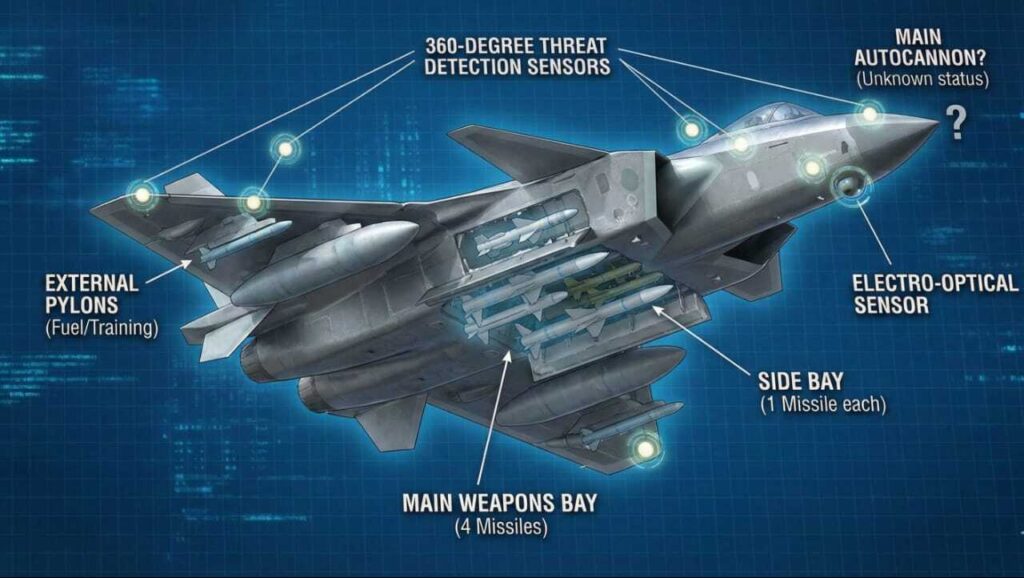
- Main Autocannon: Surprisingly, it is still unknown whether the J-20 has the main autocannon that has been associated with fighter jets for centuries. It has not been seen with a cannon so far.
- Main Weapons Bay: Located in the lower part of the aircraft, it can hold four missiles (air-to-air or air-to-ground).
- Side Bay: An additional missile can be stowed in the internal side bay, bringing the total to six missiles.
- External Pylons: It has been seen experimenting with external pylons on the wings. Which could be used to carry additional fuel during peacetime or training operations.
- Sensors: Six sensors are mounted around the airframe, providing 360-degree threat detection. In addition, an electro-optical sensor is also mounted under the nose.
What role could the Mighty Dragon (J-20) play on the battlefield?
Given the J-20’s weapons system (especially the apparent lack of a central autocannon). Analysts have different opinions on its possible role:
- Air Superiority Fighter: This aircraft could be armed primarily with long-range air-to-air missiles. Its high service ceiling and excellent maneuverability (due to canard wings) make it ideal for this role, allowing it to evade enemy fighters and engage targets.
- Long-Range Strike Aircraft: Another theory is that it is designed to penetrate enemy radar systems and destroy critical targets.
Best guess: The J-20 is designed to be multi-role so that it can adapt to any role such as air superiority, ground strike, or naval strike. In particular, it could play a key combat role in any potential conflict with the US in the Pacific, targeting naval targets or airborne radar assets.
US vs CN: Where does the J-20 stand against US fighters?
The comparison of China’s and the US’s fifth-generation fighter jets is often debated.
Numbers and Production:
Aircraft | Country | Current Estimate | Status |
- J-20 | China | 150 – 200 | Growing. (expected to become backbone of Chinese air force in the next decade) |
- F-35 | US | 450+ | Production ongoing |
- F-22 | US | 186 | Production halted |
It is expected that the number of fifth-generation fighter jets on both sides will be roughly equal in the next decade.
Weapons Capability (Internal Bays)
Aircraft | Country | Internal Missiles (Air-to-Air) | Autocannon |
- J-20 | China | 6 missiles | No cannons seen yet (probably none) |
- F-35 | US | 4 missiles | 25mm autocannon present |
- F-22 | US | 8 missiles | Autocannon present |
Analysis: The J-20 is slightly behind the F-22 in terms of the number of internal missiles. But is better than the F-35 (in stealth mode). The J-20’s lack of cannon can be compensated for by external weapon pods, however, this will reduce its stealth capability.
Combat Range and Flight Characteristics
Combat Radius: The J-20 leads in this area, with a range of between 1,200 and 2,700 kilometers. This gives it the ability to launch attacks far from the Chinese coast.
Maximum Altitude: According to the report, the J-20 can fly to a higher maximum altitude than its competitors.
Maneuvering and Speed
- Maneuverability: Most analysts rate the J-20 higher in this regard, especially due to the canard wings and possibly thrust vectoring engines. However, the F-22 is still considered the “top” of maneuverability.
- Maximum Speed: The J-20 can technically reach a maximum speed faster than the F-22, but the F-22 is capable of maintaining higher speeds for longer periods of time even without the constant use of afterburners.
Is the J-20 really a “stealth” fighter?
It’s impossible to be completely sure about stealth capabilities without fighting, but here’s what military experts have to say:
- Comparison: Many analysts believe the J-20’s stealth capability is superior to Russia’s Su-57 and could potentially be on par with the US’s F-35.
- Canard issue: According to some experts, the presence of canard wings on the J-20 could be detrimental to its stealth profile (as seen on other jets).
- Conflicting reports: India has reported that it was able to detect the J-20 while flying close to the border, but it’s also possible that the J-20 is not trying hard to hide itself.
The bottom line: It’s impossible to say for sure how stealthy the aircraft actually is.
J-20 “theft” allegations: Was it copied?
One of the biggest controversies surrounding the J-20’s development is that China is accused of stealing information from outside sources to develop the aircraft:
F-35 data leak: Between 2008 and 2014, data breaches involving Chinese nationals exposed thousands of classified documents related to the development of the F-35.
Similarity: Many experts believe that the stealth technology used in the J-20, as well as the design of the nose and intake, were inspired by or stolen from American programs. Details of the F-35’s highly advanced electro-optical sensors were also leaked.
Russian influence: Some also see design similarities to the Russian prototype MiG-1.44, which was canceled 20 years ago.
What is the truth?
While the F-35 data leak is an embarrassing piece of evidence, the J-20 appears to be a composite of three different jets (the F-35, the F-22, and the MiG-1.44). It is not a complete copy, especially the two-seat ‘B’ variant is a unique feat of Chinese engineering.
Final Verdict: The J-20 is one of the world’s most advanced fighter jets with great potential to play a multi-role combat role. Although it is surrounded by controversy, there is no doubt that it has brought China into the realm of fifth-generation stealth aircraft.
fifth-generation fighter jets, stealth technology in aircraft, radar-evading fighter planes, Chinese air force advanced jets, future air combat aircraft, next-gen military aviation, PLA Air Force fighter jet, advanced aerospace technology
, China military strategy, air superiority aircraft
